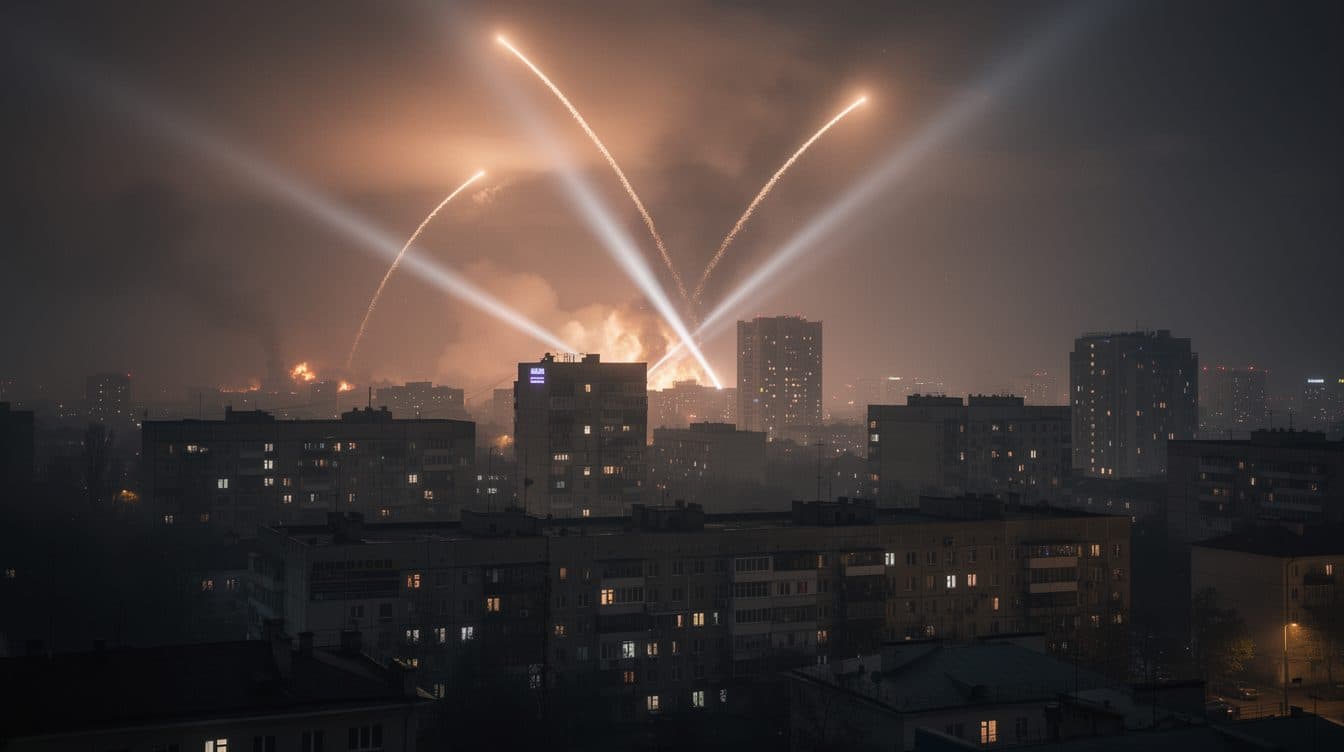
Russia launches massive missile and drone air attack on Kyiv and other Ukrainian cities
Kyiv, June 2, 2026
AI-generated image (flux-2/pro-text-to-image via Kie.ai)
Summary
On the night of June 1-2, 2026, Russia launched a massive attack with ballistic missiles, cruise missiles, and drones against Kyiv and other Ukrainian cities, causing at least one fatality and about twenty injuries in the capital. President Volodymyr Zelenskyy had previously warned of a possible major strike, while 56 UN member states condemned the impact of Russian drones in Romania.
Kyiv, June 2, 2026
On the night of June 1-2, 2026, Russia attacked the Ukrainian capital, Kyiv, and other cities in the country with a massive combined assault of ballistic missiles, cruise missiles, and drones, which caused multiple fatalities, the partial collapse of a 24-story residential building, and power and water outages in the capital.
The massive attack on the capital
The night-time attack, which lasted for several hours, was one of the most intense against the Ukrainian capital since the start of the war. In the city center, with about three million inhabitants, loud explosions were heard that shook several districts and caused scenes of panic among residents, according to international media covering the war in Ukraine. Ukrainian air defenses were active throughout the early morning in an attempt to intercept the large volume of Russian projectiles.
Ukrainian authorities confirmed that at least one person died and twenty others were injured in Kyiv as a result of the bombings. The military administrator Tymur Tkatschenko communicated this data through his Telegram channel, where the victim toll was updated as rescue teams combed the affected areas. Across the country, the toll could be higher, as several cities were hit in the same operation.
Residential buildings devastated in Solomjanskyj
In the Solomjanskyj district, one of the hardest hit, a series of projectiles hit several residential buildings. According to eyewitnesses cited by international agencies, a missile directly hit a 24-story building, which partially collapsed as a result of the explosion. Another attack damaged the upper floors of a 15-story building, while a third building, also 24 stories high, and another 20-story building, suffered significant structural damage, according to reports from Ukrainian authorities.
Kyiv Mayor Vitali Klitschko warned that several people could be trapped under the rubble and urged residents to stay away from the disaster areas so as not to hinder the work of emergency services. Firefighters and rescuers worked throughout the night in the collapsed buildings, amid the risk of further collapses and the presence of fallen glass and electrical wires. Fires broke out in several parts of the city, affecting homes and commercial premises.
Thousands of capital residents sought refuge in metro stations and air-raid shelters set up by municipal authorities, a practice that has become common in Kyiv since the start of the full-scale Russian invasion. Air-raid sirens sounded several times throughout the night, forcing residents to interrupt their sleep and descend into basements and underground stations, where they remained until the alert was lifted.
The attack also caused temporary power outages and water supply problems in several neighborhoods of Kyiv. Ukrainian energy companies worked to restore service in the hours following the bombing, although repair work was hampered by the magnitude of the damage to the power grid. The capital's hospitals treated the injured, some of them in serious condition, and prepared their emergency services for the possibility of further casualties.
The city of Dnipro, in east-central Ukraine, was another of the hardest hit during the night. Local authorities reported at least four deaths and sixteen injuries in the attack, although other sources raised the death toll to six and the number of injured to 36. Rescue teams in Dnipro also worked among the rubble of damaged buildings, while emergency services treated the injured transferred to hospitals.
Other Ukrainian cities under fire
In Kharkiv, the country's second-largest city, the mayor reported at least ten people injured as a result of the Russian bombings. The city, located near the Russian border, has been a frequent target of attacks in recent months, and its air defense systems unsuccessfully attempted to intercept several projectiles launched from Russian territory. Several residential districts suffered damage, and fires were reported in homes and urban infrastructure.
Russia also attacked targets in the city of Zaporizhzhia, in southern Ukraine, where explosions were heard and material damage was reported, although a high number of casualties had not been confirmed in that city for the moment. The extent of the attack on multiple cities simultaneously tested Ukraine's air defense systems, which had to distribute their resources along a very wide aerial front.
According to the Ukrainian Air Force, Moscow used ballistic missiles and cruise missiles in the attack, along with an unprecedented number of drones of various models. In total, Russia launched 656 drones and 73 missiles against Ukraine as part of this operation, of which 602 drones and 40 missiles were shot down or intercepted by Ukrainian defenses, according to data provided by the authorities. The high proportion of intercepted ammunition reflects the effectiveness of the anti-aircraft systems, but it did not prevent a significant number of projectiles from reaching their targets.
Zelenskyy's warnings and Russia's response
Ukrainian President Volodymyr Zelenskyy had warned the previous night, in his Monday video message, about the possibility of a major strike by Russia. In his speech, he stated: "Die Information des Geheimdienstes über einen möglichen massiven Angriff bleibt aktuell." The head of the Ukrainian state insisted that intelligence service alerts about new Russian attacks remained in effect and urged the population not to let their guard down.
A few hours after the attack, Zelenskyy reiterated the gravity of the situation. "Geheimdienstwarnungen bezüglich russischer Angriffe bleiben in Kraft. Ein massiver Schlag ist möglich, sie haben dies vorbereitet," the president stated, emphasizing that a large-scale strike was possible and that Russia had been preparing for it. These warnings coincide with the magnitude of the attack suffered by Kyiv and other cities, which seems to confirm the worst fears of the Ukrainian intelligence services.
The Ukrainian president also highlighted the importance of "Operation Pawutina" ("Spiderweb"), launched a year ago and aimed at Russian military and energy targets. Zelenskyy framed the Russian attack as retaliation for Ukrainian operations against refineries and other energy facilities in Russian territory, which have dealt a blow to the Kremlin's war economy. In this context, Russia announced that it would respond with "systematische Schläge" against military targets and decision-making centers in Kyiv, as it had warned the previous week.
Russia justified the wave of attacks as retaliation for a drone attack last month on a dormitory in the occupied Luhansk region, which killed 21 people, according to Russian sources. Moscow accused Ukraine of attacking a civilian target, while Kyiv categorically denied bombing any civilian object in that region and maintained that its operations were exclusively directed at military targets. The war of narratives surrounding the Luhansk incident illustrates the difficulty of verifying the accusations of both sides in the conflict.
On the international stage, the attack coincided with an emergency session of the UN Security Council in which 56 member states condemned the fall of Russian drones in Romania, a NATO member country. These incidents, attributed to Russia's war against Ukraine, provoked a strong diplomatic reaction from allied countries, which demanded that Moscow respect the airspace of the Atlantic Alliance member states. The multilateral condemnation reflects growing international concern about the escalation of the conflict.
International reaction and economic consequences
As an economic measure linked to the conflict, Russia announced the previous week a ban on exporting aviation fuel until the end of the month, in retaliation for Ukrainian drone attacks against Russian refineries and other energy facilities. This decision, which affects the international kerosene market, occurred at a time of tension in fuel supply and added another element of economic pressure to the conflict, with repercussions extending beyond Ukraine's borders.
The Ukrainian Armed Forces and emergency services continued search and rescue operations on June 2 among the rubble of damaged buildings in Kyiv, Dnipro, and other affected cities. Municipal authorities asked residents to report any missing persons and to refrain from approaching the disaster areas. Meanwhile, Zelenskyy held contacts with international allies to coordinate the response to the attack and request the urgent dispatch of additional air defense systems and ammunition to counter the renewed wave of Russian bombings.
The attack on June 1-2 occurred just ten days after another massive Russian bombing of Kyiv with ballistic missiles and drones, confirming Russia's strategy of repeatedly striking the capital to undermine the morale of the population and the resistance capacity of the Ukrainian state. The repetition of these attacks raises questions about the capacity of Ukrainian air defenses, which, despite having intercepted a high percentage of projectiles, have not been able to prevent several residential buildings from suffering considerable damage and a significant number of civilian casualties and injuries.
Questions & Answers
Which Ukrainian cities were attacked by Russia on the night of June 1-2, 2026?
Russia launched a massive missile and drone attack against Kyiv, Dnipro, Kharkiv, and Zaporizhzhia, according to Ukrainian authorities. Kyiv was the hardest hit, with a 24-story residential building partially collapsing in the Solomjanskyj district.
What is the victim toll of the Russian attack on June 2, 2026?
In Kyiv, at least one person was confirmed dead and twenty injured, while in Dnipro, authorities reported between four and six fatalities and between sixteen and 36 injured. In Kharkiv, at
Russian attack on Kyiv: missiles, drones and victims in | quotidiano360